Case Study: RO Reject Water Treated to Protect Bio Process
A biological treatment process can be the most cost effective way to treat high COD. But not if the water contains harmful chemicals which kill the essential treatment bacteria. This is where we come in.
Industry
Petrochemicals
Equipment Capacity/Flow Rate
60m³/h
Compounds of Concern
COD
Influent Concentration
60mg/L
Treatment Targets
<30 mg/L
Unit Energy Consumption
tbc
Industry
Petrochemicals
Equipment Capacity/Flow Rate
60m³/h
Compounds of Concern
COD
Influent Concentration
60mg/L
Treatment Targets
<30 mg/L
Unit Energy Consumption
tbc
Background: New regulations, new limits
Manufacturing facilities in China are under pressure to reduce water pollution and address their water usage as part of the ‘Water Pollution Prevention & Control Action Plan’, also known as the ‘Water Ten Plan’.
The key objective of the plan is to protect surface and ground water. Heavy polluting industries like the petroleum sector have been the focal point for enforcement. Facilities found to breach specified standards under the new law face significant fines and prison sentences for directors.
Specified limits differ depending on the sector and province but are usually between < 50 or < 30 mg/L chemical oxygen demand (COD).
Jerome Budin
Wastewater consultant
Schedule a call with one of our wastewater treatment consultants at your convenience. Or you can send us an enquiry.
The revised targets enforced by the Water Ten Plan meant that industrial manufacturing sites needed to find new water technology to achieve the targets. The traditional technologies were being challenged in ways they were never designed for.
Some effluent contains persistent chemicals which can not be removed by traditional techniques, even Reverse Osmosis. But they must be removed before the effluent passes through other sensitive processes like a biological process. Otherwise the harmful chemical would damage the biological reactor’s bacteria.
This was the crux of the issue for our client in China.
What’s it like to work with Arvia?
“We have been working with Arvia to try to reuse more of our wastewater and to meet new regulations. We have seen impressive R&D results in the removal of 1-Phenoxy-2-propanol and are now looking to pilot.”
Jimmy Tian, application engineer of Zestron China
Objective: Removal of recalcitrant organics from reverse osmosis reject water to protect a downstream bio process
Arvia were approached by one of the world’s largest petrochemical companies who are involved in the processing, production and sales of petroleum refining and petrochemical products.
The company has a refinery in the East of China and was looking to improve its wastewater treatment process to comply with environmental regulations and reduce operational maintenance of their on-site effluent treatment process.
Water Treatment Target
The petrochemical facility in Nanjing, China wanted to treat the recalcitrant refinery effluent so it could pass safely on to their biological process. This effluent was from a reverse osmosis system (or RO system), which concentrates harmful chemicals into the reverse osmosis reject water, or ‘RO reject stream’.
This RO reject stream needed to be fed into a biological process but the chemicals in the effluent would destroy the bacteria which is central to the biological process action.
The purpose of our work in this application was to remove the most persistent organic chemicals to protect the biological treatment step which was further downstream. If the chemicals from the RO stream were to react with the biology, this vital water treatment step would be damaged and would become ineffective.
Our client needed to reduce the recalcitrant COD to <30 mg/L. The RO reject stream had a flow rate of 60m³/h and a concentration of 60mg/L COD.
Water Treatment Solution
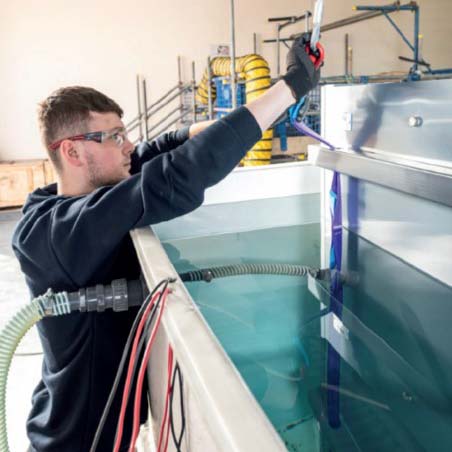
Our team conducted treatability trials at the client’s facility in Nanjing, China on samples of the refinery effluent from the RO stream.
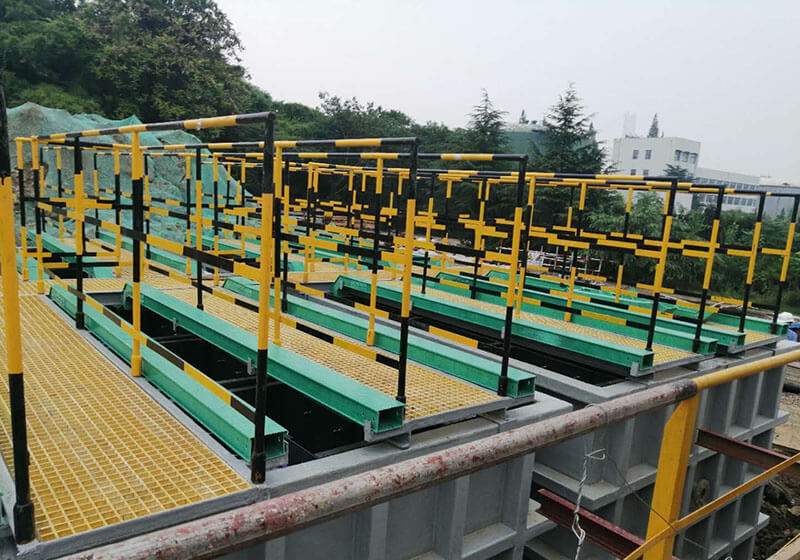
Following these trials, a NyexTM water treatment system was installed. This consisted of a set of submergible reactors inside a treatment basin.
The treatment technology combined adsorption with electrochemical oxidation to reduce the hazardous organic compounds to water and gases, which were vented safely away.
Free industrial wastewater consultation
Tell us what organic compounds you need to remove from your water and our consultants will give their recommended approach which might involve:
Engineering assessment of your water profile
Treatability trial to scope the pilot
Optioneering to determine best solution
New Water Technology Design Using Nyex™
The RO stream was gravity fed into the treatment basin. Then atmospheric pressure drove the water into the base of each reactor and up through a bed of our Nyex™ adsorbent media. Due to the use of gravity and pressure, there was no need to pump the water, which saved the client significant OpEx.
Our Nyex™ media inside each reactor localised the harmful organic chemicals onto its surface and these pollutants were then simultaneously oxidised using an electrical current. The treated water then flowed out over the top of the reactors and was directed out of the basin for further water treatment processes.
The Water Treatment Process Design
The purpose of the Nyex™ in this application is to remove the most persistent organic chemicals to protect the biological treatment step which is further downstream. If the chemicals from the RO stream were to react with the biology, this vital water treatment step would be damaged and would become ineffective.
Water Treatment Results
Using Nyex™ technologies we achieved a COD reduction down to 12mg/L at a flow rate of 60mg/L. This was better than the target of <30mg/L and was sufficient to protect the downstream biological process.
Due to the flexible nature of the Nyex™ process, it can be installed as described here to support other treatment processes. It can also be installed as a final ‘polishing’ treatment step to remove any remaining recalcitrant chemicals from effluent prior to this being discharged.