1,4-Dioxane is an organic contaminant which can be found in small trace amounts in some cosmetic products. The chemical is a by-product of some chemical manufacturing processes. This case study detail how our proven water treatment technology removes 1,4-Dioxane to trace levels.
Industry
Speciality Chemicals
Equipment Capacity/Flow Rate
1m3/day
Compounds of Concern
1,4-Dioxane
Influent Concentration
1800mg/L
Treatment Targets
0.15mg/L
Unit Energy Consumption
1581kWh
Industry
Speciality Chemicals
Equipment Capacity/Flow Rate
1m3/day
Compounds of Concern
1,4-Dioxane
Influent Concentration
1800mg/L
Treatment Targets
0.15mg/L
Unit Energy Consumption
1581kWh
Problem/Objective 1,4-Dioxane removal from water
A market leader in the production of speciality chemicals approached Arvia with the goal to remove 1,4-Dioxane from their wastewater. The client was looking for an effective water treatment process to reduce the levels of 1,4-Dioxane from their effluent.
The company has seven sites that use 1,4-Dioxane in ethoxylation processes within their global manufacturing facilities. Some client facilities are in the USA where new legislation restricts the amount of 1,4-Dioxane allowed in effluent to 1 µg/L. The client objective is to remove 1,4-Dioxane from 1800 mg/L to 0.15 mg/L to comply with current restrictions.
Jerome Budin
Wastewater consultant
Schedule a call with one of our wastewater treatment consultants at your convenience. Or you can send us an enquiry.
“Arvia have been interested, attentive and very knowledgeable in our project for treatment of API residues in waste. Their technology is innovative and has been proven to solve our waste issue.”
Pharmaceutical company, US
The problem of 1,4-Dioxane in water
1,4-Dioxane has been listed as a chemical of high concern in several US states due to the fact it is a potential carcinogen and has been detected in ground water across the country. This has raised awareness of the potential dangers of 1,4-Dioxane and in turn has led to our client’s customers asking how they plan to stop 1,4-Dioxane from entering the environment. This customer pressure has forced our client to approach us for our solution to remove 1,4-Dioxane from water.
Free industrial wastewater consultation
Tell us what organic compounds you need to remove from your water and our consultants will give their recommended approach which might involve:
Engineering assessment of your water profile
Treatability trial to scope the pilot
Optioneering to determine best solution
Our Solution: How to remove 1,4-Dioxane from water
Our client has used granular activated carbon (GAC) on other sites but are not keen on the idea of trapping the 1,4-Dioxane in the GAC and moving it somewhere else.
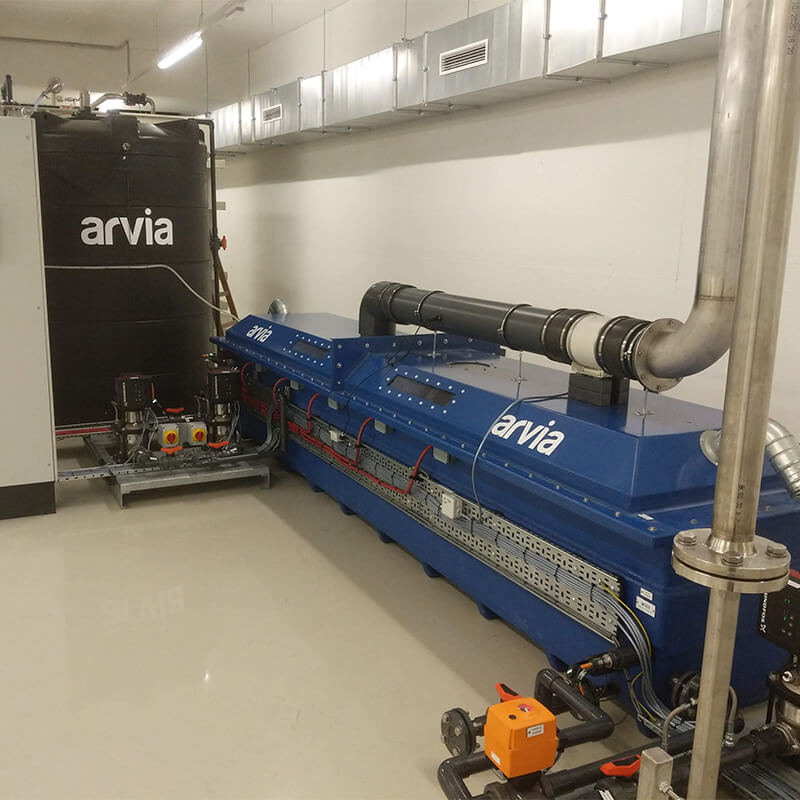
As an alternative solution to GAC, we proposed our Nyex Ellenox water treatment technology which is an electrochemical oxidation process that produces powerful hydroxyl (·OH) radicals that remove pollutants such as 1,4-Dioxane from industrial wastewater. Through the treatment process the ·OH radicals eliminates the organic contaminant which then fully mineralises the chemical into gas, that is safely vented away, and water which leaves as clean effluent.
The Nyex Ellenox process allows our client to save on operating costs and enables them to utilise an eco-friendly solution with no chemical dosing or toxic sludge to deal with.
The original objective of our client was to reduce 1,4-Dioxane from 1800 mg/L to 0.15 mg/L.
We worked closely with the client, testing samples provided from a manufacturing site on both the Nyex Rosalox and Nyex Ellenox systems to determine which system had the best performance. It was found the Nyex Ellenox treatment process is the most suitable treatment to remove 1,4-Dioxane from the client’s industrial wastewater.
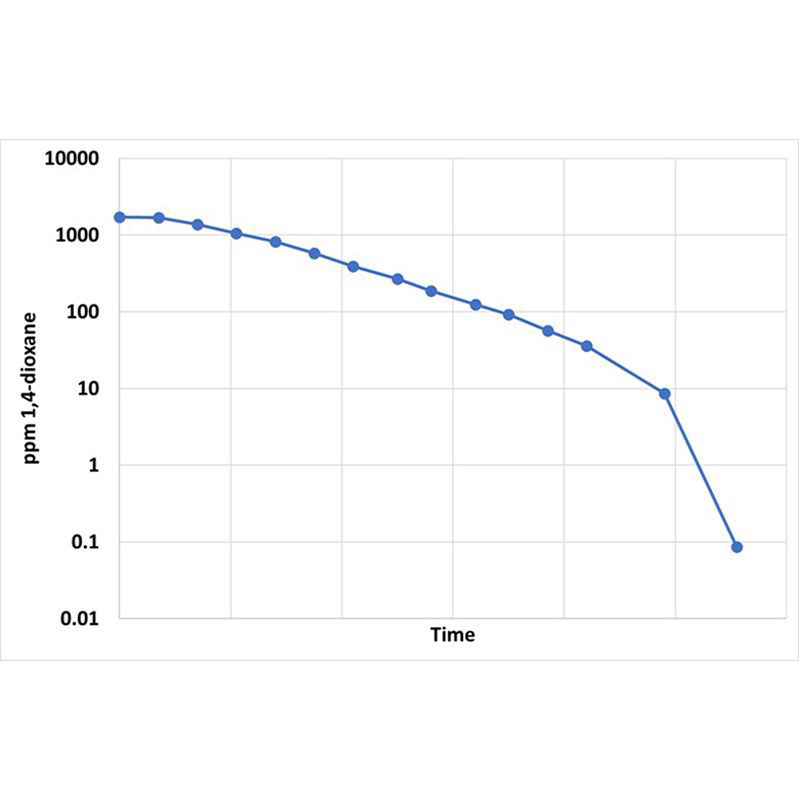
Arvia deployed the Nyex Ellenox treatment method and in 55 hours the Ellenox reached 0.009mg/l which required 1581k kWh/m³ of energy. We successfully exceeded our clients original target and removed 1,4-Dioxane all the way down to trace levels.
The graph shows the treatment profile for the removal of 1,4-Dioxane using the Nyex Ellenox system.
Future – 1,4-Dioxane removal from industrial wastewater
Since 1,4-Dioxane has been listed by the ECHA as a chemical of high concern, regulations have tightened regarding the usage and disposal of the hazardous substance. At Arvia we can help chemical speciality manufacturing companies with 1,4-Dioxane removal from water.
Our water treatment process is more environmentally friendly than conventional treatment processes with lower operating costs.
With more ongoing projects, we have seen that electrochemical oxidation is the most efficient method of removing 1,4-Dioxane from industrial wastewater.
People who read this also liked these case studies