Case Study: COD Removal for Water Reuse in Tobacco Manufacturing
Major tobacco processing facilities have approached Arvia to increase water reuse. This case study investigates how our client was able to reduce the overall COD (Chemical Oxygen Demand) organic loading to enable wastewater reuse.
Industry
Tobacco manufacturing
Equipment Capacity/Flow Rate
Low flow rate
Compounds of Concern
COD
Influent Concentration
50mg/L
Treatment Targets
95%
Unit Energy Consumption
2.16 kWh/m3
Industry
Tobacco manufacturing
Equipment Capacity/Flow Rate
Low flow rate
Compounds of Concern
COD
Influent Concentration
50mg/L
Treatment Targets
95%
Unit Energy Consumption
2.16 kWh/m3
Background: Water Reuse in Tobacco Manufacturing
Tobacco processing facilities have been looking for more cost-effective and sustainable methods which are in-line with their water management plans.
Fresh water costs have been rising, along with wastewater disposal costs. Many businesses are starting to think about water reuse as a way to save money and reduce environmental impact.
Irais Baizabal
Wastewater consultant
Schedule a call with one of our wastewater treatment consultants at your convenience, or you can send us an enquiry.
To reuse process water in a cost effective way, it is necessary to determine exactly which pollutants need to be removed for each purpose.
It can be much cheaper to remove pollutants from water for reuse than to pay for discharge fees plus the cost of buying more fresh water.
In this case, our client was looking for a complete closed-loop solution in which Chemical Oxygen Demand (COD) would be reduced from 50mg/L to as close to zero as possible. This wastewater could then be reused for other purposes around the facility, including cleaning.
What’s it like to work with Arvia?
“Our experience with Arvia so far has been really great. I believe there is really interest to make this into a success and the communication on this project is very good and clear.”
Chemical Engineer, Netherlands
Our Solution for COD Removal
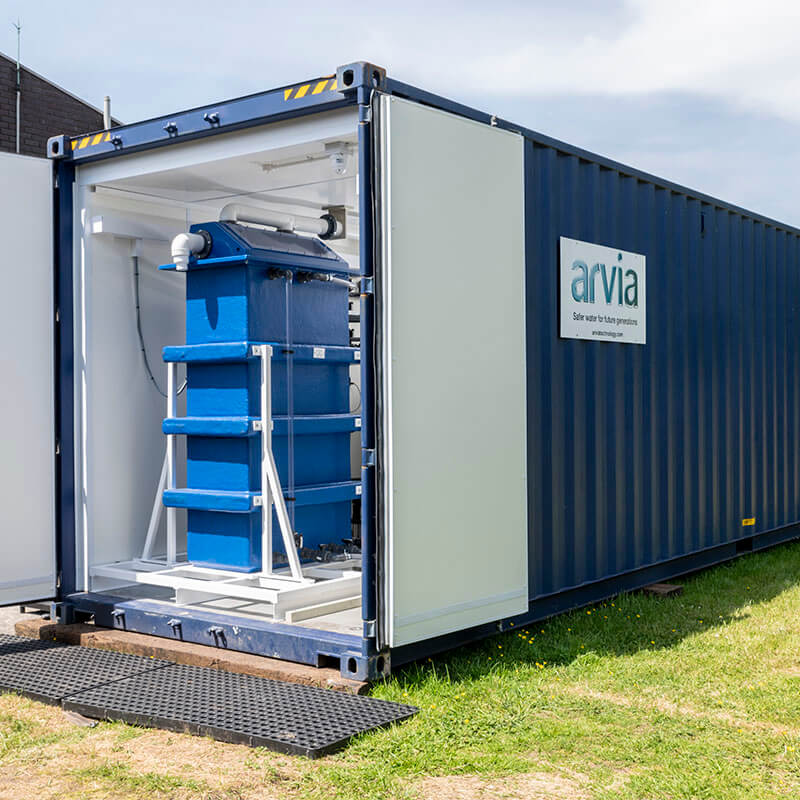
Arvia’s Nyex Rosalox system was deployed which combines adsorption with electrochemical oxidation in a single, scalable unit. Since this case study has been written, this product has been superseded by our new enhanced technology, Nyex Rosalox. You can see how this technology works in the animation here.
In both products, organic contaminants are preferentially adsorbed, localising them onto the surface of the carbon-based Nyex™ media. A low electrical current is then passed through the media bed which fully mineralises the adsorbed contaminants to H₂O, H₂ and CO₂. The electrical current simultaneously regenerates the surface of the media in-situ, allowing for further adsorption and treatment without interruption or incineration.
Results are achieved without chemical dosing or the generation of sludge reducing costs in terms of labour, transport of chemicals and specialist waste disposal.
Tell us what organic compounds you need to remove from your water and our consultants will give their recommended approach which might involve:
Engineering assessment of your water profile
Treatability trial to scope the pilot
Optioneering to determine best solution
Results
The project involved the treatment of wastewater using a Nyex™ 1-20a system at the client’s site of wastewater taken at the final stage of their existing treatment train, for advanced ‘polishing’ treatment.
The inlet water was analysed at a COD level of around 50 mg/L and final samples were just above the limit of detection, as requested.
The energy consumption was very favourable at 2.16 kWh/m3.
People who read this also liked these case studies